Face Recognition using SpikeNET
This model was published in Neural Network 2001 (see the paper section for more details).
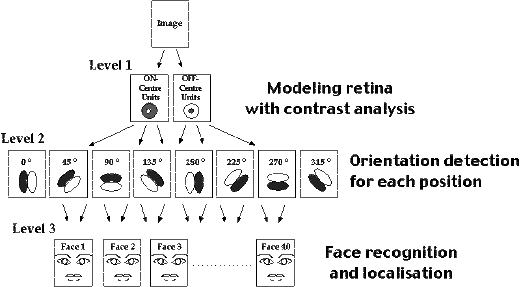
It shows how it is possible to recognize individual in natural images in a simple hierarchical network of
integrate-and-fire neurons. It is a generalization of the simple face detection model we published in 1998
(see the paper section for more details).
Description of the model
-
Arrays of integrate and fire neuron of the
size of the image
-
Visual system like architecture
Architecture of the
network

Learning
-
Supervised Learning on 8 views of 40 faces
with various contrasts and luminances.
-
Neuron selectivities were optimized using
a dicothomic algorithm
Performance of the model
B1: Learning base: 100%
(8 views of 40 faces with various contrasts
and luminances)
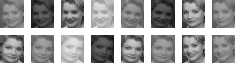
B2: Test Base 100%
(same as B1 with different contrasts and
luminances)
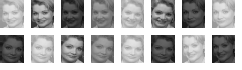
B3: New Images 97,5%
(2 unknown views of 40 faces at various
contrasts and luminances)

Resistance to contrast reduction and noise is comparable to the performance
of the human visual system
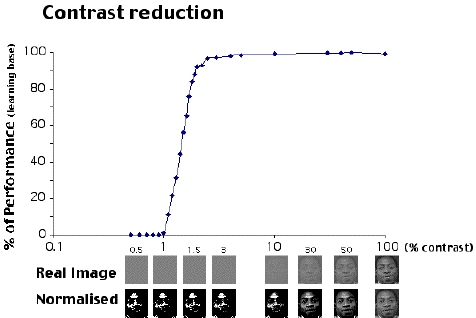
Performance of the network is affected only when contrast drop under 3%
(the example image was detected until 0.005%). These characteristics are
comparable with the capacities of the visual system

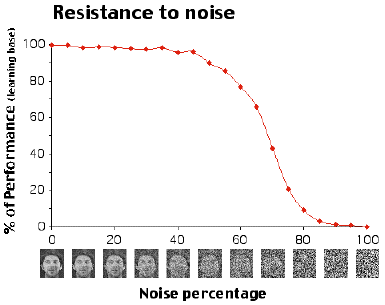
Even with 50% noise, the performance of the network remain unaffected (the
example image was the last one to be detected - with more than 90% noise).
Noisy images were calculated
in the following way. For eac pixel noisy_pixel = 1-noise_percentage*initial_pixel
+ noise_percentage*white_noise
Propagation of the 10 views of the 40 faces
-
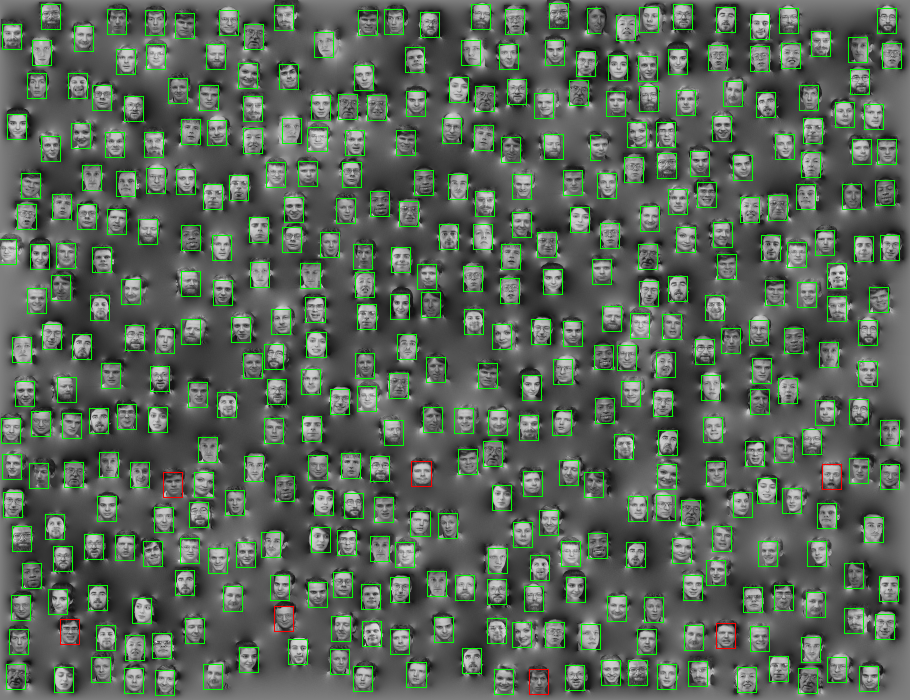
All the images were put together and it represents
31 850 000 neurons and more than 245 000 000 000 connections
-
Faces inside green rectangles were accurately
recognized. Faces inside red rectangles were missed
-
SpikeNET processes this big image in under
15 minutes on a 266Mhz G3 PowerMac and in under 3 minutes on a home made
6 pentium 400Mhz cluster running linux.
click to download the full
image