Slow oscillations to structure human memory
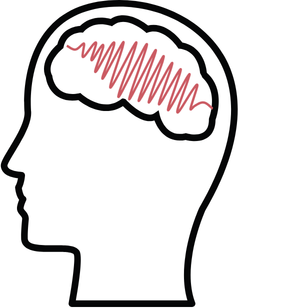
How does the human brain coordinate the activity of distributed neuronal populations to form, consolidate, and recall memories? Researchers from the CNRS (CerCo, Toulouse) and their collaborators at the ICM (Paris) and the University of Oxford (UK) discovered a novel mechanism: slow oscillatory bursts (~2 Hz) in the hippocampus, which dynamically structure brain activity during learning and recall.
Macular degeneration: retraining the brain to compensate for vision loss
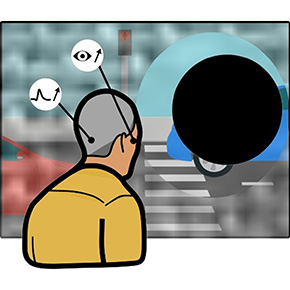
Macular degeneration leads to a gradual loss of central vision and, to date, has no curative treatment. In this study, published in Investigative Ophthalmology & Visual Science, patients with age-related macular degeneration (AMD) underwent four weeks of motion perception training. The results show a significant improvement in performance, which transfers to other tasks and is accompanied by changes in the activity of the brain circuits involved in vision.
Conférence-démo | Le sens du mouvement
Du mar. 24.03.2026 19:00
au mar. 24.03.2026
IN MEMORIAM Michel Imbert (1935–2026)
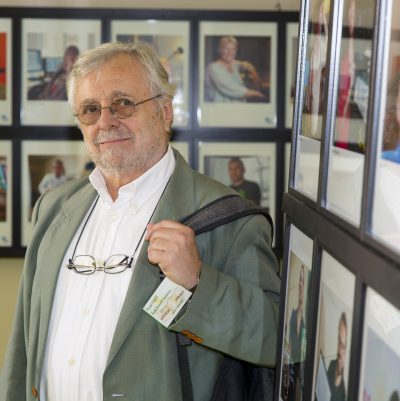
Michel Imbert was an internationally renowned researcher in Neurosciences of Vision and a true pioneer of interdisciplinarity. Following his initial training in philosophy and psychology, he specialized in neuroscience. His work primarily focused on the cortical processing of sensory information and the convergence of visual, auditory, and somatosensory modalities in cats...
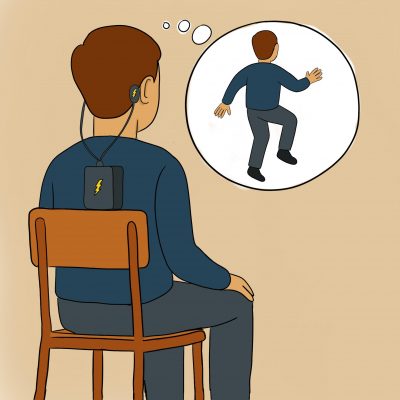
Everything You Always Wanted to Know About Galvanic Vestibular Stimulation… But Were Afraid to Ask!
Galvanic vestibular stimulation (GVS) is the art of exploring our sense of balance… with a little electricity! By applying mild electrical currents behind the ears, this method allows for artificial activation of the vestibular system—without any actual head movement. Located in the inner ear, this sensory system is composed of three semicircular canals and the otolithic organs, which detect head rotations and accelerations. GVS directly stimulates this motion-sensitive system, all while keeping the subject perfectly still.
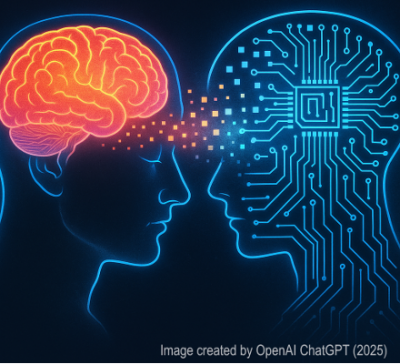
Consciousness, neurotechnologies and AI? Can memories and mind be transferred and recreated?
Check out recent work done on the Mind at the CerCo!

Les innovations méthodologiques peuvent-elles contribuer à faire progresser les recherches en paléoneurologie ?
Dans le cadre du projet « EndoMap: Mapping the brain of our ancestors »
Caroline Fonta du CerCo, en collaboration avec Amélie Beaudet du PALEVOPRIM, cherche à comprendre comment notre cerveau a évolué. Pour répondre à cette question, et en l’absence de tissu mou dans le registre fossile, il faut s’intéresser à l’analyse des crânes, souvent incomplets, de nos ancêtres et parents éloignés
.
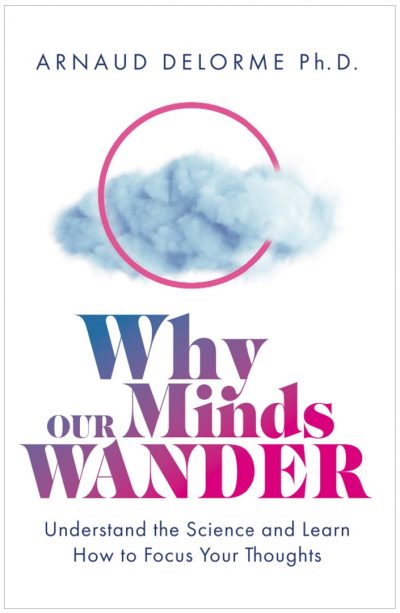
Why Our Minds Wander?
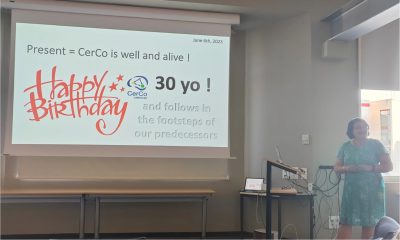
CerCo celebrated its 30th anniversary on June 6!
Following this memorable day, the laboratory director and all its members would like to thank the many participants who made the celebration a success. The richness of the presentations, the many exchanges during the convivial moments and the dance floor, which was packed until late, were a true reflection of CerCo!
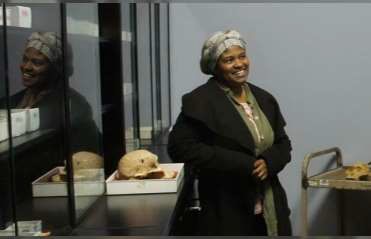
What can we learn from South Africa about human origins? Dr Mirriam Tawane
This conference is organized as part of a PHC collaboration by Caroline Fonta of CerCo with the University of the Witwatersrand (South Africa) and the Endomap project (https://www.endomap.org/).